Mediterranean islands face compounded climate risks, not only from sea-level rise but from increasing drought and aridity. These trends undermine water security, public health, and local economies, core pillars of well-being. As recognized by the ICJ, climate change poses an urgent and existential threat requiring coordinated, anticipatory governance, especially for vulnerable island systems.
-
7 months назад Общедоступный
-
Suyu Liu posted in Northern Mediterranean Community
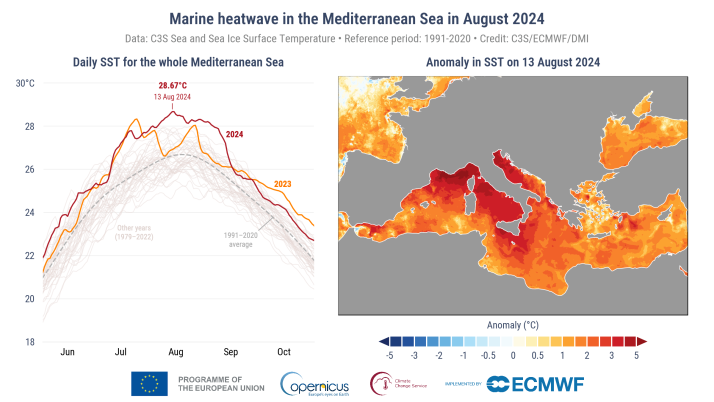
7 months назад ОбщедоступныйForwarded by Sandra Megens , we can see the Mediterranean Sea surface temperatures and changes (source: https://climate.copernicus.eu/esotc/2024/graphics-gallery/european-ocean).
-
Sara Riade created an event in Global Community
-
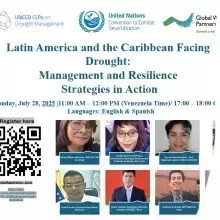
Sandra Megens created new community content in Latin America and the Caribbean Community
-
Laurent-Charles Tremblay-Levesque created a new resource in Valuing Water Community.
-
Laurent-Charles Tremblay-Levesque created new community content in Asia Community
-
Menna Ghonaim created a new resource in WEFE4MED Knowledge Hub.
-
Saida Rivero created an event in Latin America and the Caribbean Community
-
Dieudonne ILBOUDO posted in Africa Community
7 months назад ОбщедоступныйBiological Soil Crust (BSC), also known as biocrust is a living, thin layer of soil surface composed of communities of microorganisms such as cyanobacteria, algae, lichens, mosses, fungi, and other microbes, tightly bound with soil particles. These crusts play a vital ecological role in arid and semi-arid environments by stabilizing soil surfaces, reducing erosion, enhancing water retention, fixing atmospheric nitrogen, and facilitating seed germination. They improve soil fertility and structure by increasing organic matter and microbial diversity. Biocrusts are particularly important in fragile ecosystems where vegetation cover is sparse, acting as a protective layer that sustains soil health and biodiversity. However, they are highly sensitive to disturbance and take years or even decades to recover once damaged.
https://www.bosai-jp.org/en/solution/detail/89/order_list
https://www.researchgate.net/publication/360438331_Biological_soil_crus… -
Suyu Liu posted in Northern Mediterranean Community
7 months назад ОбщедоступныйI think this research article is a good review of existing studies on water consumption in the tourism industry in Spain, which can possibly benefit other N. Mediterranean countries as well, because they also have a substantial tourism industry in national economy.
The Priority of Water Consumption in the Spanish Tourism Industry: A Dilemma for Residents and Researchers
by Lázaro Florido-Benítez
Appl. Sci. 2024, 14(16), 7125; https://doi.org/10.3390/app14167125Abstract: Spain is one of the most water-stressed countries in the world. Regional governments face the challenge of ensuring long-term water security for residents and tourists. In 2024, Catalonia declared a state of emergency to tackle the problem of a lack of water. Catalonia and Andalusia regions imposed water restrictions, prohibiting residents from washing the exterior of their houses and cars or filling their swimming pools to guarantee tourism activities in hotels and other tourism companies. The research objective of the present study is to tackle the priority of water consumption in the Spanish tourism industry so that the availability of water is guaranteed for residents, without constraints on the supply. This research uses qualitative and quantitative methods to obtain a comprehensive view of the water consumption in Spain’s territory and the main zones of water scarcity that are affecting residents and the tourism industry. In addition, this study uses the Web of Science (WoS) database to analyse the bibliometrics on the topic of water consumption in the tourism industry from 2000 to 2023, as well as quantify the number of articles published by researchers. Findings reveal that although the tourism industry is the economic engine of Spain, water consumption by tourists is above the level of consumption of residents, and this asymmetrical situation should be reversed in favour of the welfare of Spanish citizens. It is noteworthy that the water scarcity in Spain and its continuing restrictions in the Andalusian and Catalonian regions have caused huge problems with drinking water supply in the last few years. Indeed, local and regional Spanish governments cannot demand that a resident consume 133 L per day, while a tourist is allowed to consume between 400 and 1000 L per day. For this reason, water availability must be a priority for residents, and after that, the tourism industry. Economic interests cannot override citizens’ needs and well-being. This research has helped us better understand the complex relationships between the use of water in the tourism industry and by residents in the context of climate change.
-
Saida Rivero created new community content in Global Community
-
Saida Rivero created new community content in Global Community
-
Suyu Liu posted in Northern Mediterranean Community
7 months назад ОбщедоступныйIn the UK, a few places near the Thames River, start to restrict water use due to drought and heat waves. https://www.bbc.co.uk/news/articles/cp90p2zz999o
How about Northern Mediterranean, which is often dry and hot during summer? -
Sara Riade posted in Global Community
7 months назад Общедоступный🌬️ Join Us for the UNCCD CLP Learning Exchange on Combating Sand and Dust Storms 🌍
🗓️ Date: July 15, 2025
🕙 Time: 10:00–11:00 (CET)
📍 Virtual Event (Zoom)
🔗 Register here: https://lnkd.in/djpW_xKCTo mark the International Day of Combating Sand and Dust Storms, the UNCCD Global Communities for Learning and Practice (UNCCD-CLP) is organizing a special Learning Exchange webinar focused on the serious environmental, health, and socioeconomic challenges posed by Sand and Dust Storms (SDS) — and what we can do to address them.
🔍 What to Expect:
Presentations by two distinguished international experts
Insights on SDS source mapping, impact assessment, and mitigation strategies
An interactive Q&A session to foster dialogue and knowledge-sharing🎤 Featured Speakers:
Prof. Ali Darvishi Boloorani, University of Tehran & UNCCD-CLP Co-Chair – Dust Source Mapping & Mitigation Strategies
Prof. Peter Tozer, Massey University – Impact Assessment: Environmental, Health, and Economic Perspectives
✅ Expected Outcomes:
Enhanced understanding of SDS and its connection to drought and land degradation
Strengthened collaboration among experts, practitioners, and policymakers
Actionable recommendations for SDS-related policy and program developmentThis session is ideal for professionals and practitioners working in:
🏜️ Sand and Dust Storms
🌾 Drought resilience
🛰️ Early warning systems
🌍 Sustainable land management📩 Register now via the link above and feel free to reach out for more details. We look forward to your participation!
-
Sandra Megens created a new resource in Latin America and the Caribbean Community.
-
Ali Darvishi Boloorani created an event in Global Community
-
7 months назад Общедоступный
Dear colleagues,
I would like to take this opportunity to reiterate the information regarding the TRANSFER Danube project (InTegRAted moNitoring System For agro-climatic risks within DanubE Region), which was officially launched on 1st April 2025. This marks the beginning of a cross-border initiative aimed at enhancing climate resilience in the agricultural sector throughout the Danube Region.
Institute of Hydrometeorology and Seismology of Montenegro is one of the official partners in this project.
Implemented within the Interreg Danube Region Programme under the thematic priority “A greener, low-carbon Danube Region”, the project addresses the growing impact of climate change on agriculture. It focuses on analysing emerging patterns of extreme weather events—such as droughts, floods, and heatwaves—and on developing innovative tools and strategies to support sustainable adaptation in the agricultural sector.
A key output of the project will be the development of a transnational Danube e-platform. This platform will serve as an integrated hub of climate, water resources, and agricultural data, providing access to maps, models, good practices, and response strategies. It will also support knowledge transfer and promote cross-border cooperation by offering tools tailored to help stakeholders - especially those in vulnerable crop regions (with a focus on winter wheat and maize) - adapt to the increasing challenges of climate change. In cooperation with partners across the Danube Region, the project will establish a standardised monitoring system for the phenological status of selected agricultural crops. This will form the basis for evaluating crop-specific water balances and yield projections, ultimately strengthening climate resilience in farming communities.
Beyond technological solutions, TRANSFER Danube seeks to raise awareness among policy makers and the private agricultural sector about the long-term effects of climate change on agricultural productivity. The project’s main target groups include local and regional decision-makers, agricultural policy experts, and farmers, all of whom will benefit directly from the project’s outputs. By encouraging transdisciplinary cooperation and improving the dissemination of scientific knowledge, the project aims to increase the impact of climate and agricultural research across the Danube Region. The tools and strategies developed through TRANSFER Danube will not only serve local needs but also offer transferable solutions adaptable to other European regions facing similar climate-related challenges.
The project consortium brings together 11 partners from 9 countries: Romania, Croatia, Hungary, Germany, Bosnia and Herzegovina, Bulgaria, Czech Republic, Montenegro, and Austria.
The total project budget is EUR 1,842,379.96, of which EUR 1,473,903.96 is covered by the Interreg Danube Region Programme co-funded by the European Union (more information about the programme: https://interreg-danube.eu/). The project will be implemented over 30 months, running from April 2025 to September 2027.If you find it interesting, for more information visit project website: https://interreg-danube.eu/projects/TRANSFER-Danube.
-
Sandra Megens created a new resource in Latin America and the Caribbean Community.
-
Laith Ali Naji posted in Asia Community
7 months назад ОбщедоступныйThe Risk of PFAS in Iraq’s Groundwater Amid Drought: Insights from Asia-Pacific Experiences
Because of the ongoing drought, many people in Iraq have no choice but to consume groundwater without realizing the potential risks of Per- and polyfluoroalkyl substances (PFAS) contamination. PFAS, often called “forever chemicals,” are a growing global concern due to their persistence in the environment and potential health risks. While many countries are still catching up in addressing PFAS pollution, several Asian countries are taking concrete steps to monitor, regulate, and reduce PFAS in the environment. Asia-Pacific countries are increasingly addressing PFAS ("forever chemicals") through regulations mainly aligned with the Stockholm Convention, which restricts certain PFAS substances such as PFOS, PFOA, and PFHxS. Key points include:
1- China, Japan, and South Korea have adopted restrictions on PFAS listed in the Stockholm Convention. China is enhancing broader chemical regulations, including a 2023 List of New Pollutants for Priority Management [1].
2- Japan has been proactive, since 2009, PFOS is regulated as a Class I Specified Chemical Substance, with export restrictions. In 2020, Japan set a drinking water target of 50 ng/L for PFOS and PFOA and banned their manufacture and use [7].
3- Southeast Asian countries such as Vietnam, Thailand, Singapore, Malaysia, and the Philippines have documented widespread PFAS contamination in water, soil, and biota, with ongoing concerns about human and ecosystem health. However, regulatory frameworks remain weak or poorly enforced in many of these countries [5][6].
In Iraq, PFAS pollution is not yet a visible part of water management strategies, and current efforts are limited to occasional workshops for university staff. However, with ongoing drought and increasing reliance on untreated groundwater in urban peripheries, the risk of PFAS contamination in drinking water will only grow. Early action is essential. Drawing from Asia’s experiences, Iraq can consider:
1- Establishing a national PFAS monitoring program, starting with pilot studies in industrial and military areas.
2- Developing laboratory capacity and training for PFAS testing using GC-MS instruments.
3- Including PFAS in national water quality and environmental protection regulations.
4- Collaborating with regional and international partners to develop cost-effective removal and monitoring methods.Reference
[1] https://www.idtechex.com/en/research-article/new-regulations-targeting-…
[2] https://www.sciencedirect.com/science/article/abs/pii/S0013935121004163
[3] https://ipen.org/documents/pfas-pollution-across-middle-east-and-asia
[4] https://www.sciencedirect.com/science/article/abs/pii/S2352801X23000474
[5] https://www.frontiersin.org/journals/toxicology/articles/10.3389/ftox.2…
[6] https://ipen.org/news/pfas-situation-reports-twelve-middle-eastern-and-…
[7] https://int.anteagroup.com/news-and-media/blog/pfas-regulation-around-t…
[8] https://www.3eco.com/article/2025-asia-pacific-regulatory-landscape-3e/
[9] https://landandgroundwater.com/global-pfas-regulatory-developments/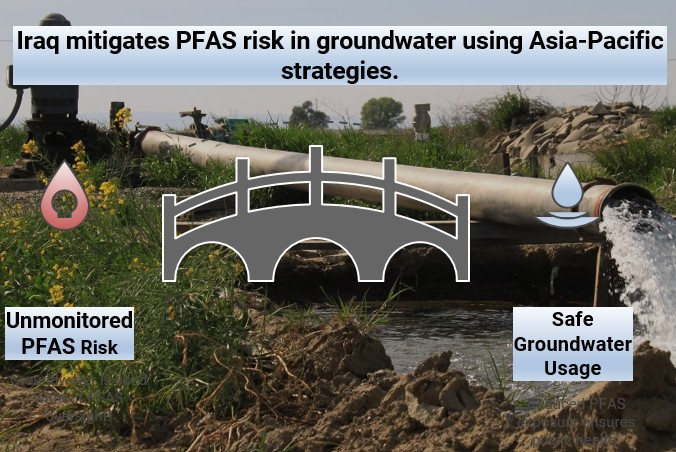
-
Sandra Megens created new community content in Latin America and the Caribbean Community