A New Approach to Improving Drought Resilience in Desert Ecosystem Restoration
Recurring drought and accelerating desertification are placing increasing pressure on dryland ecosystems, leading to reduced vegetation cover, soil degradation, and the decline of essential ecosystem functions. Under these conditions, ecological restoration—ranging from soil stabilization to the re-establishment of protective plant cover—has become both urgent and increasingly challenging due to limited water availability.
One practical response to this challenge is the use of deep root-zone irrigation, a technique that delivers water directly to subsurface soil layers where plant roots are most active. By reducing surface wetting, this approach helps limit water losses through evaporation and runoff while improving plant access to moisture under drought conditions.
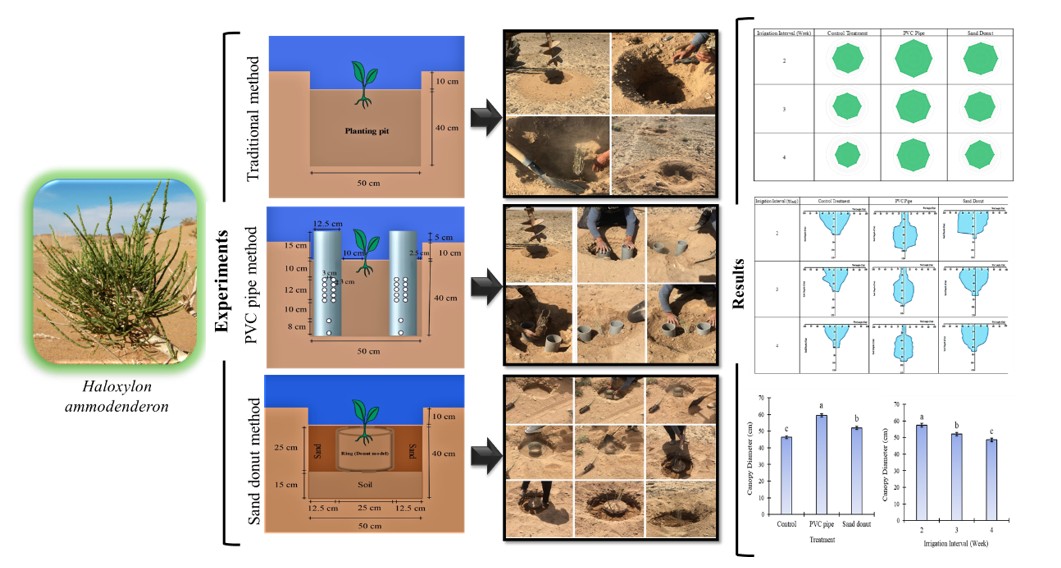
Building on this concept, our research team has applied the pipe method as a targeted deep-irrigation solution. In this method, irrigation water is conveyed through a perforated pipe and released within the root zone, creating a deeper and more stable moisture distribution compared with conventional surface irrigation. This results in more efficient water use, improved soil moisture conditions, and stronger plant establishment in water-limited environments.
The findings show that the pipe method can contribute to more resilient restoration outcomes by combining water savings with improved plant performance.
Details of this work have been published in the journal Land Degradation & Development. https://doi.org/10.1002/ldr.70076